
- By BitSeed
- Voice Technology
- 18 Sep
How Does Speech Recognition Technology Work in Edge Devices?
The implementation of speech recognition technology in edge devices essentially involves a profound restructuring of computing architecture. Traditional cloud-based speech recognition relies on powerful server computing capabilities and massive data processing capacity, while edge deployment requires the same functionality to be achieved on microcontroller-level hardware. This shift has spawned全新的技术路径, with model compression emerging as a key breakthrough.
Current mainstream model compression technologies include three core methods: quantization, pruning, and knowledge distillation. Quantization technology reduces model parameters from 32-bit floating points to 8-bit integers, which can reduce model size by 75% while maintaining over 98% accuracy. In practical applications, speech recognition models processed through quantization can be compressed to 1/16 of their original size, enabling intelligent hardware equipped with the MXNet lightweight inference engine to achieve speech feature analysis capabilities of 120 frames per second. Pruning technology removes redundant neurons or connections to reduce computational complexity while maintaining model performance; typical cases show that it can increase model inference speed by 40% and reduce memory usage by 60%.
As an end-to-end optimization solution, knowledge distillation transfers feature representations from large models to small models, successfully compressing 200MB-level speech models to within 15MB while maintaining 99.3% of the original model performance. The collaborative application of these technologies enables speech recognition models to achieve inference latency reduction to within 23 milliseconds on ARM architecture chips, nearly a 4-fold improvement compared to industry benchmarks three years ago.
Technological Innovation in Edge Computing Frameworks
The optimization of edge computing frameworks is the critical infrastructure for the successful deployment of speech recognition technology. Modern edge computing architectures adopt collaborative innovation between distributed nodes and localized data processing capabilities, breaking through the response latency bottleneck of traditional cloud computing models. Device-side lightweight inference engines can shorten speech feature extraction time to within 20 milliseconds, reducing interaction latency by 83% compared to cloud transmission solutions.
Notably, the introduction of federated learning frameworks enables distributed nodes to complete model iteration through encrypted gradient transmission without sharing original speech data, ensuring privacy security while maintaining a monthly recognition accuracy improvement rate of 13.6%. This technical architecture has demonstrated significant value in highly sensitive scenarios such as financial voiceprint authentication, enabling end-to-end response speeds to break through the 200-millisecond critical threshold and meet the interactive experience standards of natural human dialogue.
Feature extraction algorithms using sliding window mechanisms reduce speech signal processing energy consumption by 42%. Combined with adaptive learning optimization technology, the system can automatically switch noise reduction model versions based on environmental noise levels. In the industrial quality inspection field, this architecture already supports parallel processing of 200 voice channels, and with asynchronous execution engines, end-to-end inference latency is stably controlled within the 120-millisecond threshold.
Specialized Evolution of Hardware Platforms
The successful operation of speech recognition technology in edge devices离不开专业化硬件平台的支撑. Current mainstream edge AI chip architecture designs exhibit multiple heterogeneous characteristics, with audio DSPs and audio NPUs becoming indispensable components. Taking the R329 chip jointly launched by Allwinner Technology and Arm China as an example, it integrates 5 computing cores: AIPU, DSP, CPU, and dual-core HIFI4. Optimizations in precision and algorithm移植速度 have led to exponential growth in customers' deep learning computing power requirements for chips.
Specialized speech AI chips typically feature both high computing power and low power consumption to enable battery-powered devices to be wake-up capable. They need to be equipped with at least 2MB of SRAM, and memory bandwidth in low-power states needs to be at least greater than 600MB/S. In a technical solution where speech signal processing and up to 50 offline command words run on a single DSP, recognition rates can reach over 90% in noisy environments. This technological breakthrough enables devices such as AR glasses to实现全语音操作 in harsh industrial environments without internet connectivity.
The development of TinyML technology provides new possibilities for speech recognition at the microcontroller level. TinyML device shipments are projected to surge from 15 million in 2020 to 2.5 billion by 2030. This technology optimizes algorithms through methods such as quantization, pruning, and model compression, enabling machine learning models to run efficiently on resource-constrained devices like microcontrollers, typically with operating power consumption in the milliwatt range, making them suitable for battery-powered devices.
In-depth Penetration of Application Scenarios
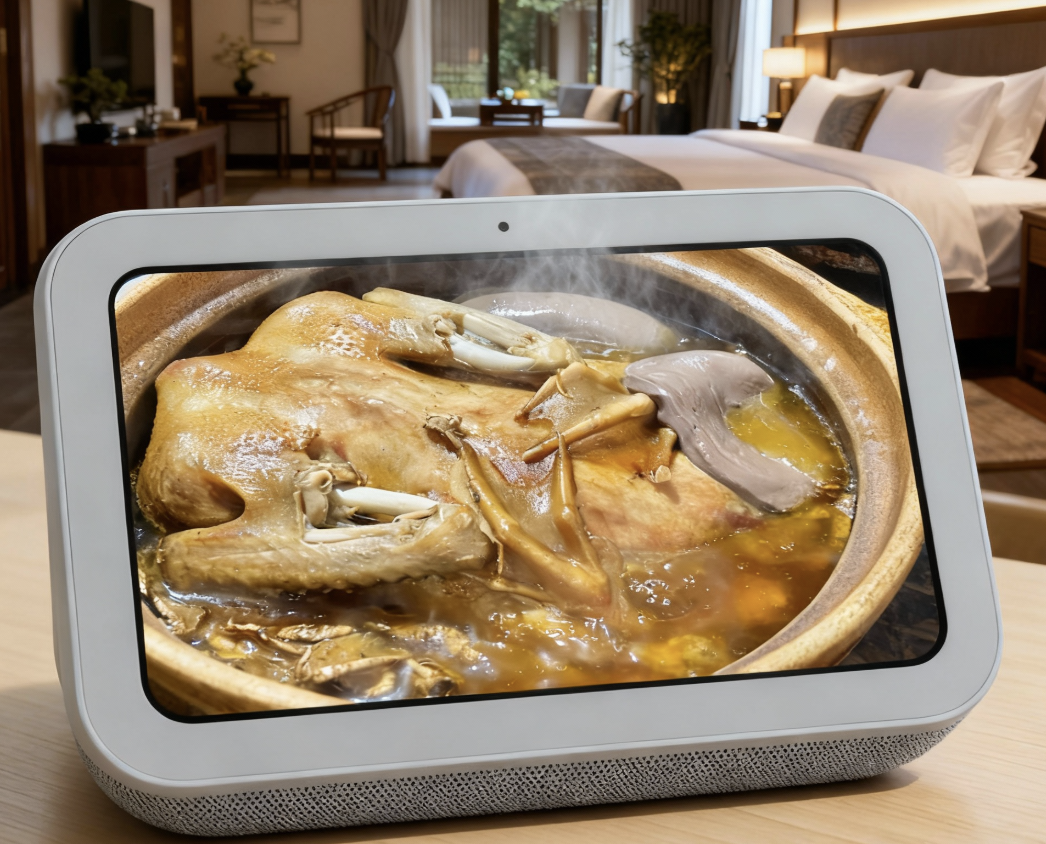
The application of speech recognition technology in edge devices is正在向更多垂直领域深度渗透. In hotel room scenarios, intelligent voice interaction terminals, as the closest touchpoints to guests, provide instant response service experiences through edge computing capabilities. The global smart hotel market size reached $11.29 billion in 2024 and is projected to increase to $52.82 billion by 2029. This rapid growth provides broad space for intelligent upgrades of hotel rooms!
Smart speakers, as important carriers of voice interaction, although showing adjustment trends in the consumer market, are demonstrating new growth momentum in commercial application fields. In the first half of 2024, China's smart speaker market sales reached 8.055 million units. Among them, screenless smart speakers are evolving towards mid-to-high-end, with the market share of high-quality products featuring high sound quality and attractive design开始增长. New smart speaker models equipped with self-developed AI large models have monthly sales approaching 10,000 units, showing the promoting effect of technological upgrading on the market.
In the industrial sector, edge deployment of speech recognition technology provides new solutions for predictive maintenance. Through hierarchical sparse pruning strategies, the ResNet-50 model size can be compressed by 76% while maintaining 98.3% of the original recognition accuracy, enabling efficient extraction of vibration signal features. Measured data from a smart home enterprise shows that after integrating a federated learning-based distributed training framework, the recognition error rate of wake words with regional accents decreased by more than 42%.
Technical Challenges and Development Prospects
Despite significant progress in the application of speech recognition technology in edge devices, many technical challenges remain. The balance between accuracy and efficiency is始终是核心难题. How to maintain sufficient model performance while achieving extreme compression requires continuous technological innovation. Hardware compatibility issues are also prominent, as different edge chips vary greatly in support for sparse computing and low bit-width, requiring developers to具备 cross-platform optimization capabilities.
Insufficient model generalization ability is another key challenge, with a 15-20% accuracy drop across scenarios being common in actual deployments. Poor adaptability to dynamic environments also restricts large-scale application of the technology; situations where network jitter causes inference failure rates to exceed 5% need to be addressed by establishing dynamic compensation mechanisms. In addition, the lack of security protection systems results in model tampering detection rates below 70%, which constitutes a major hidden danger in application scenarios with high security requirements.
Looking to the future, the development of speech recognition technology in edge devices will呈现出 several important trends. Firstly, the technology stack will further mature; the collaborative development of model compression, hardware acceleration, and framework optimization will increase edge inference speed by 2-5 times and reduce energy consumption by 60-80%. Secondly, application scenarios will continue to expand; from smart homes to industrial automation, from medical monitoring to education and training, voice interaction will become a standard method of human-computer interaction. Finally, the ecological system will improve; integrated software and hardware solutions will lower technical barriers and promote large-scale application of speech recognition technology in edge devices.
 28 Oct, 2025