
- By BitSeed
- Voice Technology
- 18 Sep
Analysis of Technical Implementation of Voice Wake-Up
Billions of "Hey Siri" and "Xiao Ai Tong Xue" (Little Ai Classmate) are spoken worldwide every day, yet the technical principles that actually make devices "wake up" remain little-known. A qualified wake-word system needs to maintain a false rejection rate below 5% in noisy environments while controlling false wake-ups to within 0.5 times per hour—which means the system allows only 36 false triggers when processing 10,000 hours of audio. Behind this extreme precision lies an exquisite integration of audio signal processing, deep learning, and edge computing technologies.
The conversion from sound waves to features is the first step in wake-word detection. The original audio signal first passes through a pre-emphasis filter to enhance high-frequency components and improve the signal-to-noise ratio. Next, the system frames the audio with a 10-millisecond interval and 25-millisecond window length, and each frame is converted into a frequency domain representation via Short-Time Fourier Transform (STFT). The resulting linear magnitude spectrogram requires further processing—it is mapped to the mel scale through a mel filter bank, a non-linear frequency mapping that better aligns with human auditory perception. Finally, by taking the logarithm and applying Discrete Cosine Transform, Mel-Frequency Cepstral Coefficients (MFCC) are obtained, typically configured as 13-40 dimensional feature vectors that retain key speech information while significantly reducing data dimensionality.
The choice of deep learning model architecture directly impacts wake-up performance. Current mainstream solutions adopt a hybrid architecture of Convolutional Neural Networks (CNN) and Recurrent Neural Networks (RNN). CNNs are responsible for extracting local time-frequency patterns—using depthwise separable convolutions to reduce parameters while maintaining feature extraction capability; RNNs or their variants LSTM/GRU capture temporal dependencies to recognize the complete phoneme sequence of the wake word. Latest research shows that Res2Net-based architectures, through multi-scale feature fusion, better handle wake words at different speech rates, reducing false rejection rates by over 12%. The introduction of attention mechanisms enables the model to focus on key segments in the audio, further improving detection accuracy.
A two-stage detection strategy resolves the conflict between real-time performance and accuracy. The first stage uses a lightweight feature extractor that processes audio frames every 80 milliseconds, generating a confidence score between 0 and 1. The model used in this stage is typically only a few tens of kilobytes and can run in real-time on low-power DSPs. When the confidence exceeds an initial threshold, it triggers the second stage of fine-grained verification—which uses a more complex encoder model to analyze longer audio contexts, combining acoustic and language models for final determination. This cascaded architecture ensures both low-latency system response (typically <100ms) and effectively reduces false wake-up rates.
Optimization strategies for edge deployment are key to enabling全天候监听. Through 8-bit fixed-point quantization, model size can be compressed to 1/4 of the original while controlling accuracy loss within 2%. Structured pruning removes entire convolutional filters to further reduce computational load. Knowledge distillation allows small models to learn the output distribution of large models, reducing parameters by 10 times while maintaining performance. On ARM Cortex-M4F processors, optimized models require only 2-3 milliseconds per inference with power consumption below 1 milliwatt, sufficient to support long-term operation of battery-powered devices.
Training custom wake words presents unique challenges. Unlike fixed wake words where massive real data can be collected, custom wake words typically have only a few dozen samples. The solution involves using Text-to-Speech (TTS) systems to generate synthetic data, augmented through techniques like pitch shifting, time stretching, and noise injection to expand the training set. Research shows that proper data augmentation can reduce false rejection rates by 38% in few-sample scenarios. Transfer learning is also critical—starting from a pre-trained general wake-word model and fine-tuning only the last few layers to adapt to new wake words, significantly reducing training time and data requirements.
Noise robustness determines the practical value of the system. Real environments contain various interferences—background conversations, music, mechanical noise, etc. Multi-condition training exposes the model to clean speech mixed with various noise samples, enabling it to learn target feature extraction in complex acoustic environments. Traditional noise reduction techniques like spectral subtraction and Wiener filtering serve as preprocessing steps to improve signal-to-noise ratio. Latest research employs audio-visual multimodal fusion, using cameras to capture speakers' lip movements for auxiliary judgment, increasing detection accuracy by 15% under extreme noise conditions.
False wake-up suppression requires precise threshold tuning and negative sample training. The system must distinguish similar pronunciations—"Hey Siri" vs. "Hey Syria", "Xiao Ai Tong Xue" vs. "Xiao Ai Tong Xue" (homophonic near-misses). By collecting大量相似词汇 and daily conversations as negative samples, the model's discriminative ability is trained. Dynamic threshold adjustment adaptively changes sensitivity based on ambient noise levels and usage scenarios—in quiet environments increasing sensitivity to reduce false rejections, and in noisy environments decreasing sensitivity to avoid false wake-ups. Research data shows that proper threshold strategies can reduce false wake-up rates from 13 times per hour to near zero.
Privacy protection is achieved through on-device processing. All wake-word detection is completed locally on the device, with only post-wake-up speech transmitted to the cloud for subsequent processing. Audio data is cyclically overwritten in buffers and not stored long-term. Some systems employ federated learning to continuously improve model performance while protecting user privacy—device-side computes model updates without uploading raw audio, only aggregating encrypted gradient information to the server.
Power optimization involves hardware-software co-design. Dedicated voice wake-up chips integrate optimized DSP units and neural network accelerators, enabling wake-up detection at extremely low power. Hierarchical wake-up strategies keep the system in low-power listening mode most of the time, activating the main processor only when human-like sounds are detected. Some advanced systems use analog neural networks to process audio signals directly in the analog domain, eliminating ADC conversion power overhead and reducing standby power to the microwatt level.
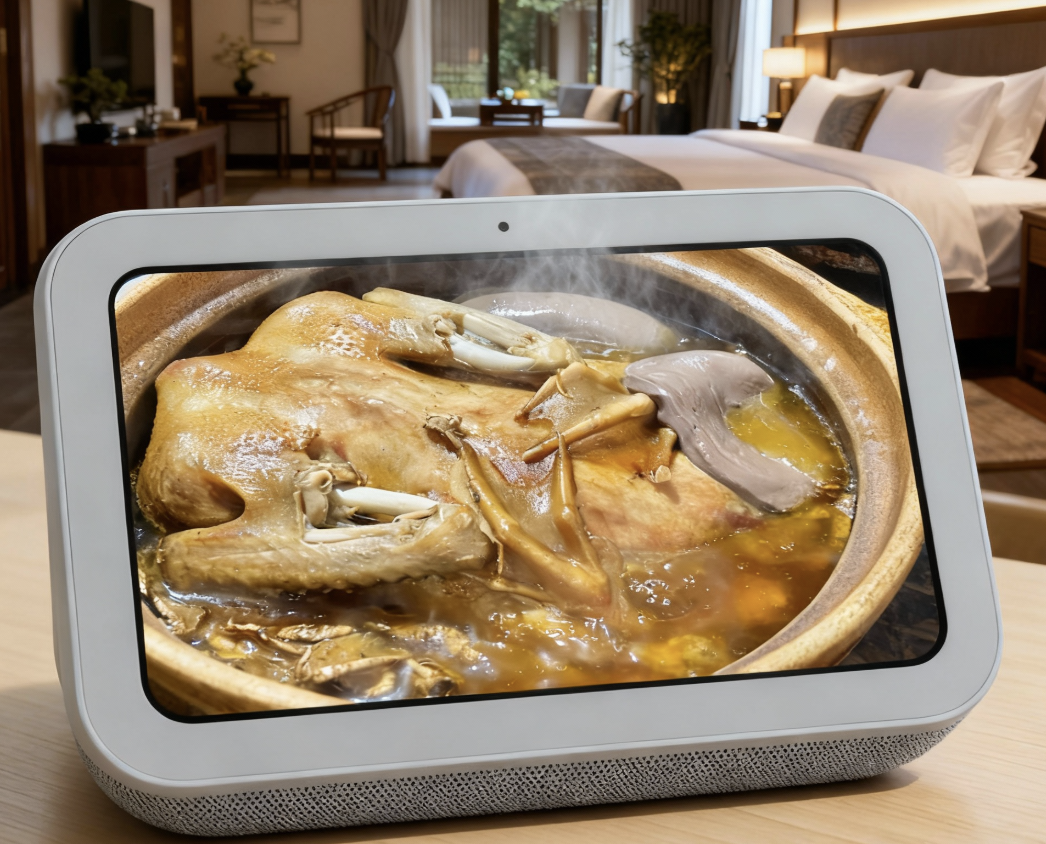
As an AI voice interaction terminal provider, we have accumulated rich experience in wake-word technology practice. By adopting self-developed neural network architectures, optimized feature extraction algorithms, and efficient edge deployment solutions, our smart speaker products achieve reliable voice wake-up in various complex environments. In hotel room scenarios, the system needs to filter air conditioning noise and corridor sounds; in educational settings, it must handle interference from multiple simultaneous speakers. These challenges drive our continuous algorithm optimization, ultimately achieving industry-leading wake-up performance.看似简单的"wake-up" function is actually a perfect combination of precision engineering and intelligent algorithms.
 28 Oct, 2025