
- By BitSeed
- Công nghệ giọng nói
- 17 Sep
What is NLP Technology and Why is It Important?
The core of NLP technology lies in enabling machines to understand the complexity of human language. Unlike structured data processing, human language is full of ambiguities, omissions, and context dependencies, making machine understanding highly challenging. A simple phrase like "turn it on" might refer to an air conditioner, TV, or curtain in different scenarios; machines need to accurately judge by combining context, user historical behavior, and even time factors.
From a technical architecture perspective, modern NLP systems typically include multiple processing layers. First is the acoustic model layer, responsible for converting audio signals into phoneme sequences. This process needs to handle interfering factors such as environmental noise, speaker accents, and speech rate variations. Next is the language model layer, which maps phoneme sequences to possible word sequences, involving N-gram models, recurrent neural networks, or Transformer architectures. Finally, the semantic understanding layer converts text into machine-executable structured instructions through techniques like named entity recognition, intent classification, and slot filling.
Word vector technology is key to NLP breakthroughs. Traditional one-hot encoding cannot express semantic relationships between words, while word embedding techniques like Word2Vec and GloVe map words to a continuous vector space, making semantically similar words close in vector space. This representation method not only significantly reduces computational complexity but, more importantly, enables models to understand the关联性 between "hotel" and "guesthouse", "air conditioner" and "temperature".
The introduction of attention mechanisms has completely changed the technical landscape of NLP. The Transformer architecture, through self-attention mechanisms, allows models to simultaneously focus on different positions in the input sequence and capture long-distance dependencies. When processing complex instructions like "Please change the alarm time set yesterday to 8 o'clock tomorrow morning", the model needs to understand the complete concept of "the alarm set yesterday" and correctly associate it with the action of "changing to 8 o'clock tomorrow morning".
Pre-trained models have greatly lowered the technical threshold for NLP applications. BERT learns general language representations on large-scale unlabeled corpora through masked language modeling and next sentence prediction tasks. This pre-training-fine-tuning paradigm allows developers to obtain excellent performance with only a small amount of fine-tuning on specific tasks, instead of training models from scratch. For terminal devices like smart speakers, this means rapid adaptation to different scenario requirements, whether it's service instruction recognition in hotel rooms or knowledge Q&A in educational scenarios.
Real-time performance is a key challenge for voice interaction terminals. Users expect immediate responses after speaking instructions, requiring the entire NLP process to be completed in milliseconds. The end-edge-cloud collaborative architecture has become the mainstream solution: lightweight models are deployed on terminals for preliminary recognition and simple instruction processing, while complex queries are transmitted to the edge or cloud for in-depth analysis. Through techniques like model quantization and knowledge distillation, we can compress originally multi-GB models to tens of MB while maintaining over 90% performance.
Multi-turn dialogue management is an advanced form of intelligent interaction. The system needs to maintain dialogue state and track the evolution of user intent. When a user says "Help me book one", the system needs to combine previous dialogue history to determine whether it's ordering food, booking tickets, or other services. Modules such as state tracking, policy learning, and natural language generation work together to ensure dialogue coherence and naturalness.
Domain adaptation is a necessary path for NLP implementation. Although general models have wide coverage, their performance in specific domains is often unsatisfactory. By collecting domain corpora, building professional dictionaries, and designing domain-specific intent systems, the accuracy of the system in vertical scenarios can be significantly improved. For example, in hotel scenarios, the system needs to understand professional terms like "extend stay", "wake-up service", and "room service"; in educational scenarios, it needs to identify subject knowledge points, problem-solving steps, and other specific expressions.
Error handling and degradation strategies are equally important. When the system cannot accurately understand user intent, how to gracefully guide the user to re-express or provide alternative solutions directly affects user experience. Through mechanisms such as confidence scoring, multi-candidate ranking, and active clarification, the system can make reasonable responses in uncertain situations and avoid negative impacts caused by executing wrong instructions.
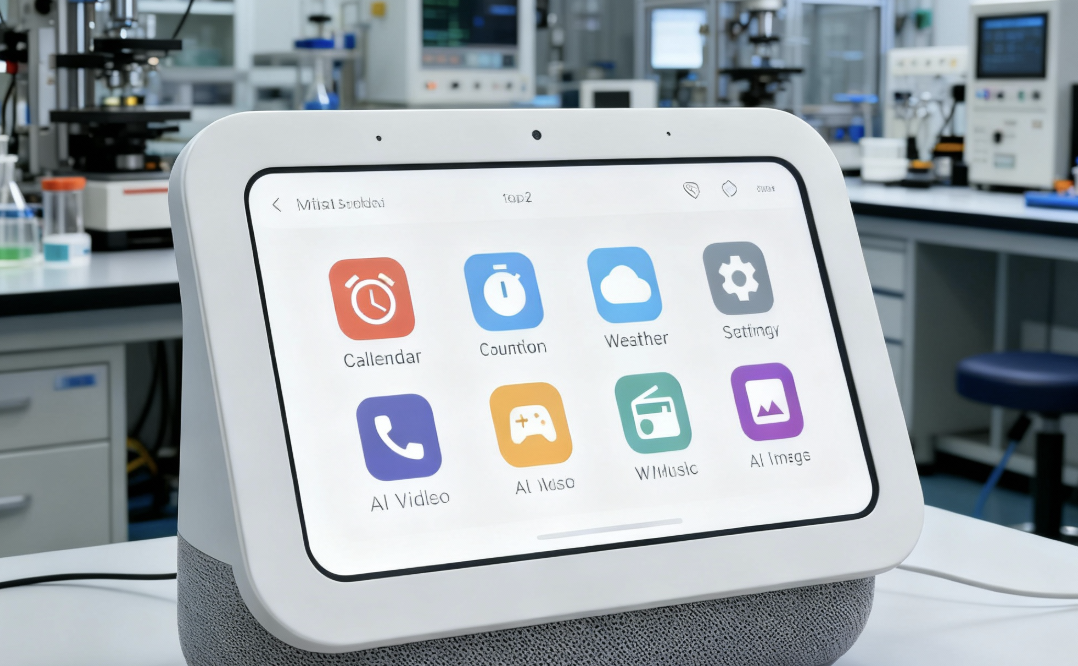
As a provider of voice interaction terminal devices, we have conducted in-depth optimization in every link of the NLP technology stack. From noise reduction algorithms at the acoustic front-end to domain customization for semantic understanding, from extreme compression of end-side models to elastic expansion of cloud services, these technical accumulations ensure the stable performance of our products in complex real environments. NLP is not just a technology but also a bridge connecting humans and intelligent devices; every advancement in it redefines the possibilities of human-computer interaction.
 28 Oct, 2025